
WHITE SPOTS
White Spots on Teeth
Without drilling, in a single visit — ICON treatment in Utrecht
White spots on teeth arise from demineralisation, fluorosis or MIH, or are left behind after braces. With the ICON treatment (resin infiltration) we make them largely disappear in a single visit — no drilling and no anaesthetic. At Top Lach in Utrecht we first establish where the spot comes from, because not every white spot responds the same way.
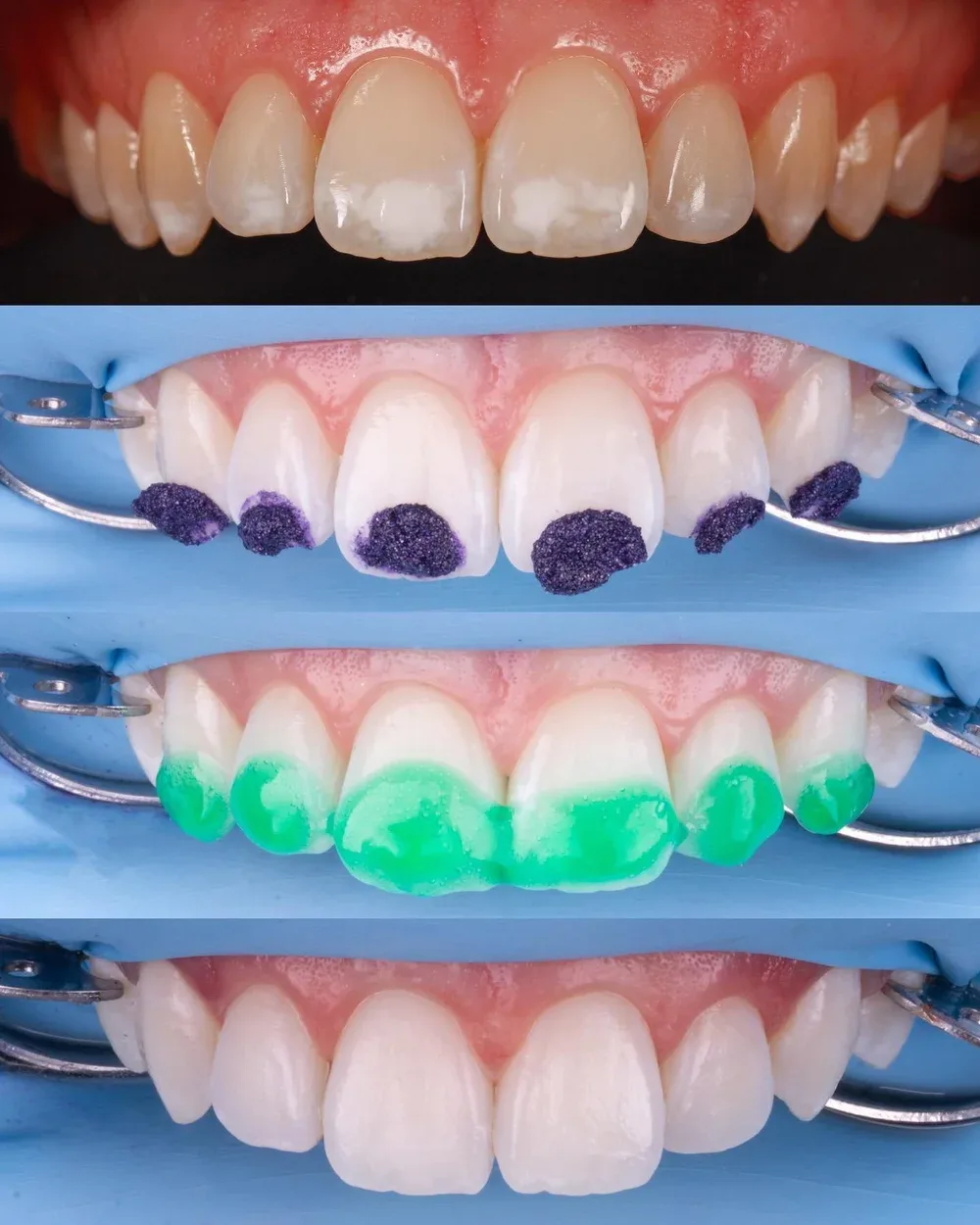
Where do white spots come from — and what helps?
A white spot is not dirt you can brush away: it is enamel whose mineral density differs from the rest of the tooth. Light refracts differently there, so you see a chalky or matt patch. The four causes we see most are demineralisation (early decay, often around a brace bracket), dental fluorosis from too much fluoride while the enamel was forming, MIH — molar incisor hypomineralisation, where the enamel of permanent molars and front teeth never fully formed — and old damage to a milk tooth that became visible in the permanent one. At Top Lach in Utrecht every treatment starts with that distinction, because it decides what will work.
The ICON treatment: caries infiltration without drilling. ICON is a low-viscosity resin that soaks into the porous enamel of the spot. The tooth is isolated first and we apply an etching gel that opens the dense surface layer of the spot. The tooth is then thoroughly dried and the infiltrating resin is drawn into the pores, where a lamp cures it. The effect is optical: the resin refracts light almost exactly like healthy enamel, so the white spot blends into the colour of the tooth around it. No drilling and no anaesthetic — for most people it feels like an ordinary cleaning with a clamp added. One appointment of about an hour is usually enough.
What ICON can and cannot do. Being honest about this saves disappointment. ICON works best on shallow white demineralisation spots — exactly the type left behind by fixed braces. Mild fluorosis usually responds well too. With deep MIH lesions, brown-discoloured patches or enamel that has already crumbled, the result is partial: the spot becomes clearly less visible but does not always vanish completely. So we sometimes combine ICON with microabrasion (polishing away a very thin layer) or finish the area with composite. What we will not do is promise a complete disappearance the spot does not allow — you see beforehand, on a photo, what result is realistic.
Whitening usually does not help — and often makes it look worse at first. This is the biggest misconception about white spots. Whitening lightens the whole tooth, including the spot: the contrast remains, and right after bleaching the spot actually stands out more, because dehydrated enamel temporarily looks whiter. That effect settles over the following days. Where the whole tooth is evenly discoloured, whitening before an ICON treatment can make sense, because the rest of the tooth then sits closer to the colour of the spot. In that case we do the whitening first, wait two weeks for the colour and the enamel's water content to stabilise, and only then infiltrate.
White spots after braces — and how to prevent them. Plaque clings easily around brackets, and that is where demineralisation begins. When the brace comes off, the spot appears all at once in exactly the shape of the bracket. That is frustrating after eighteen months of patience, but it is usually very treatable: these are shallow lesions and that is precisely where ICON is strongest. Better still is prevention — good brushing technique around the brackets, interdental brushes or a water flosser, fluoride rinse, and the extra check-ups with our dental hygienist during the brace period. Does your child wear fixed braces with us? Raise it at the next check-up; it saves a treatment later.
This information is general in nature and does not replace personal advice or diagnosis. Consult your dentist about your situation.
The ICON treatment step by step
Diagnosis
We establish what causes the spot and how deep it goes
Isolate & etch
The tooth is isolated; etching gel opens the surface layer of the spot
Infiltrate
The liquid resin soaks into the pores of the enamel
Cure & polish
Cured with the lamp and polished — you see the result immediately

FAQ
ICON is caries infiltration: a low-viscosity resin that soaks into the porous enamel of a white spot and is cured there. Because the resin refracts light almost like healthy enamel, the spot blends into the colour of the tooth. There is no drilling, no healthy tooth tissue is lost and anaesthetic is usually unnecessary.
No. Nothing is drilled and no healthy enamel is lost, so most people need no anaesthetic. What you feel is the rubber dam keeping the tooth dry and the cool air of the drying step. The treatment takes about an hour and you can eat and drink normally afterwards.
Usually not. Whitening lightens the entire tooth, spot included, so the contrast stays. Right after bleaching the spot even looks more prominent, because dried-out enamel temporarily appears whiter; that settles within a few days. Only when the rest of the tooth is clearly darker than the spot can whitening beforehand help reduce the difference — the ICON treatment then follows.
The resin sits inside the enamel itself and does not wash out, so the result is lasting by nature. The treated area can pick up slight discolouration over the years from coffee, tea or smoking — just like the rest of your teeth. Brush normally, come for check-ups and tell us if you notice a difference; touching it up is straightforward. Importantly, ICON also arrests the demineralisation at that spot, so it is not purely cosmetic.
Yes, and this is exactly the situation where ICON works best. Demineralisation spots around brackets are usually shallow, and fresh lesions respond well. Do wait a few months after the brace comes off so the enamel can recover with fluoride — sometimes the spot fades on its own. If it stays visible, we schedule the infiltration. For children too there is no drilling and no anaesthetic.
For adults, dental care falls outside Dutch basic insurance, so whether ICON is reimbursed depends on your supplementary dental policy and on the reason for treatment. A different arrangement applies to children under 18. Either way you receive a treatment plan with a cost estimate in advance, so you know the amount before we begin — and you can submit it to your insurer for certainty.
Also read on our blog
Book Appointment
Book an appointment at Top Lach dental practice in Utrecht.