
WISDOM TEETH
Wisdom Tooth Removal
In our own practice in Utrecht — including angled and impacted teeth
Not every wisdom tooth needs to come out. If it sits properly, erupts without trouble and you can keep it clean, we leave it alone. If it does cause problems — recurring inflammation, pain, or simply too little room — we remove it at Top Lach in Utrecht, in the practice itself. Raquel Ibarra is a dental surgeon on our team and performs these procedures, including when a tooth is angled or still fully within the bone.
Short answer
Does your wisdom tooth have to come out, and how is it done at Top Lach?
Not always: if a wisdom tooth sits well and causes no problems, we leave it. If it has to come out, dental surgeon Raquel Ibarra removes it here in the practice under local anaesthetic, even when the tooth is angled or still in the bone. Most people are back at work after two to four days.
Wisdom teeth: when to remove and when not to
The most persistent misconception is that wisdom teeth have to come out regardless. They do not. Wisdom teeth are the third molars, usually erupting between seventeen and twenty-five. If the tooth stands upright, there is enough room, it comes through fully and your toothbrush can reach it, there is no reason at all to remove it — it is simply a molar doing its job. We remove a wisdom tooth when there is a demonstrable reason: recurring inflammation of the gum around it (pericoronitis), decay in the wisdom tooth or in the molar in front of it that can no longer be restored, pressure or pain, or a tooth lying at such an angle that it damages its neighbour. When in doubt we would rather wait and monitor than take out a healthy tooth. When that balance tips is set out in wisdom teeth: when to remove them.
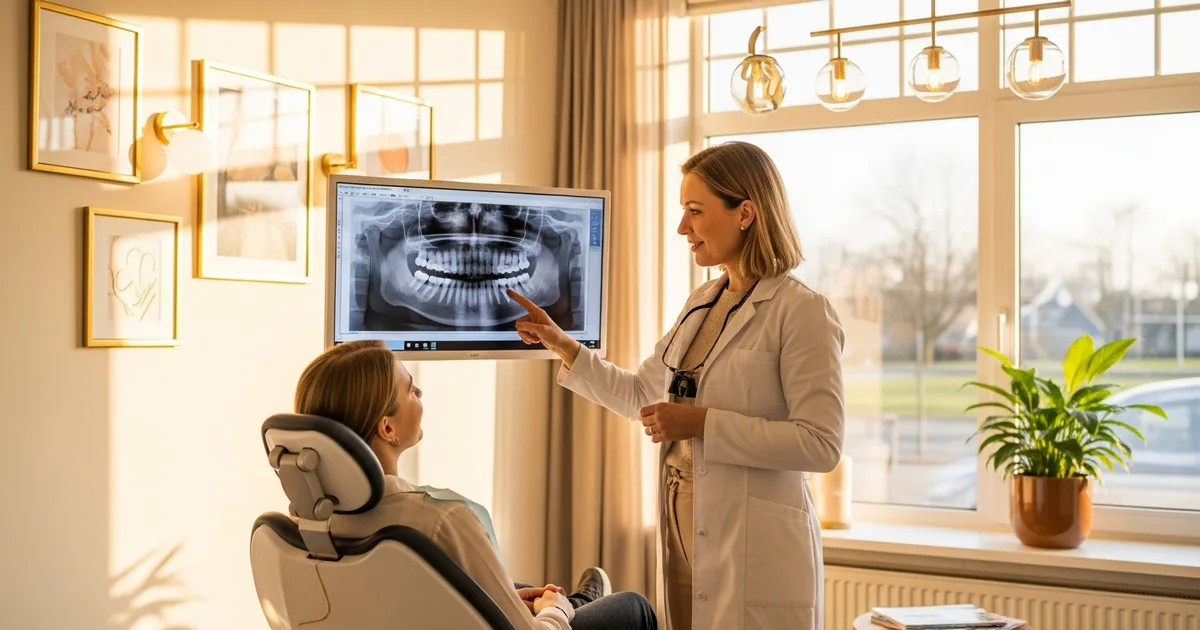
The procedure takes place here in our practice. Raquel Ibarra is a dental surgeon, implantologist and periodontist on our team, and she carries out the wisdom tooth removals — including the harder cases, where the tooth lies at an angle, has only partly erupted, or is still entirely within the jawbone. That means you are treated in the same practice that holds your records, where your own dentist knows your teeth and where you come back for the follow-up. Before the procedure your jaw is imaged: on a panoramic X-ray we assess the position of the tooth, the shape and number of its roots, and its relationship to the nerve in the lower jaw and the sinus in the upper jaw. Where an ordinary X-ray does not make that relationship clear enough, we add a 3D scan. That assessment determines how the procedure is approached and what we discuss with you beforehand.
How the procedure itself goes. You are given a local anaesthetic so you feel no pain during the procedure — you will feel pressure and movement, which is normal. If the tooth stands clear and has fully erupted, it is often an ordinary extraction taking a few minutes. If the tooth sits under the gum or in the bone, the surgeon makes a small opening in the gum, exposes a little bone if needed, and sometimes removes the tooth in sections; that last part sounds more drastic than it is and actually spares the surrounding tissue. The wound is then sutured. Most procedures take twenty to forty-five minutes. If you are anxious about dental treatment, say so beforehand: we take extra time, explain each step before we do it, and agree a stop signal with you.
Recovery: what is normal and when to call us. The first few days are the busiest. Expect swelling that peaks on day two or three, a stiff or tender jaw, and sometimes bruising in the cheek — unpleasant, but normal. Cooling during the first twenty-four hours helps with the swelling. Take painkillers as agreed with you, do not rinse on the first day, do not smoke and do not drink through a straw: the sucking motion can dislodge the blood clot that has to protect the wound. Eat soft, lukewarm food and chew on the other side. Most people are back at work after two to four days; after a heavier procedure, or with physical work, it can take longer. Contact us if pain gets worse after day three instead of better, if you develop a fever, if bleeding does not stop when you bite down on a gauze pad, or if numbness in the lip or chin persists. Those are the things we want to see — and we would rather hear from you too early than too late; outside opening hours, dental emergencies explains how to reach us.
Angled and impacted wisdom teeth, and the nerve in the lower jaw. A wisdom tooth that does not stand upright but tilts forward often pushes against the molar in front of it. That creates a gap no brush can clean, and that is exactly where decay begins — not rarely in the healthy molar next to it, which then has to be treated as well. That is one of the clearest reasons to remove a wisdom tooth after all, and sooner rather than later: in young adults the roots are often not yet fully formed and bone heals faster. The lower jaw also carries a sensory nerve for the lip and chin, sometimes running right past the root tips of the wisdom tooth. We assess that distance on imaging beforehand and discuss with you what we see. In rare cases a temporary numb feeling in the lip or chin can occur after the procedure; it matters that you know this in advance rather than being taken by surprise. As far as we are concerned that explanation is part of the treatment, not part of the small print.
This information is general in nature and does not replace personal advice or diagnosis. Consult your dentist about your situation.
From consultation to follow-up
Consultation & X-ray
We assess whether the tooth needs removing and, if so, its position, roots and nerve
Plan & estimate
You hear what the procedure involves and receive a treatment plan with an estimate
The procedure
Under local anaesthetic, by our own dental surgeon — usually 20 to 45 minutes
Recovery & follow-up
Clear aftercare instructions to take home, sutures out and a check of the wound


FAQ
No. If the wisdom tooth sits well, has fully erupted, causes no symptoms and you can keep it clean, we simply leave it and keep an eye on it at your six-monthly check-up. We remove it when there is a reason: recurring inflammation, pain, decay that cannot be restored, or damage to the molar next to it.
Not during the procedure: you are given a local anaesthetic. You will feel pressure, movement and sometimes sound — that is normal and does not mean the anaesthetic is failing. Afterwards, once it wears off, the area is tender for a few days; we advise you on pain relief. If you do feel sharp pain during the procedure, raise your hand: more anaesthetic can always be given.
Swelling is usually worst on day two or three and then subsides. Most people are back at work after two to four days; with heavy physical work or a more difficult procedure it can take longer. If you can, schedule it at the start of a few quiet days, and arrange transport if you are very apprehensive. Leave sport and heavy lifting alone for the first week.
Yes. Raquel Ibarra is a dental surgeon on our own team and performs the wisdom tooth removals here in the practice, including when the tooth is angled or still in the bone. So you stay in the practice that holds your records and where you return for the follow-up. Exactly what your situation calls for we determine together with you, based on the X-ray and the examination.
For children under 18, dental care falls under Dutch basic insurance. For adults it does not, so reimbursement depends on your supplementary dental policy. You will not hear the cost afterwards — you receive a treatment plan with an estimate in advance, which you can submit to your insurer if you wish. The tariffs themselves are set nationally by the NZa and are identical for every dentist in the Netherlands.
After an extraction a blood clot forms in the socket, protecting the bone underneath. If that clot comes loose or dissolves too early, the bone is exposed: that is a dry socket. The recognisable pattern is pain that gets worse on day three or four instead of better, often radiating to the ear, sometimes with a bad taste. Smoking and drinking through a straw make it more likely. It is very treatable — call us and we clean the socket and place a dressing that settles the pain quickly.
Also read on our blog
Book Appointment
Book an appointment at Top Lach dental practice in Utrecht.